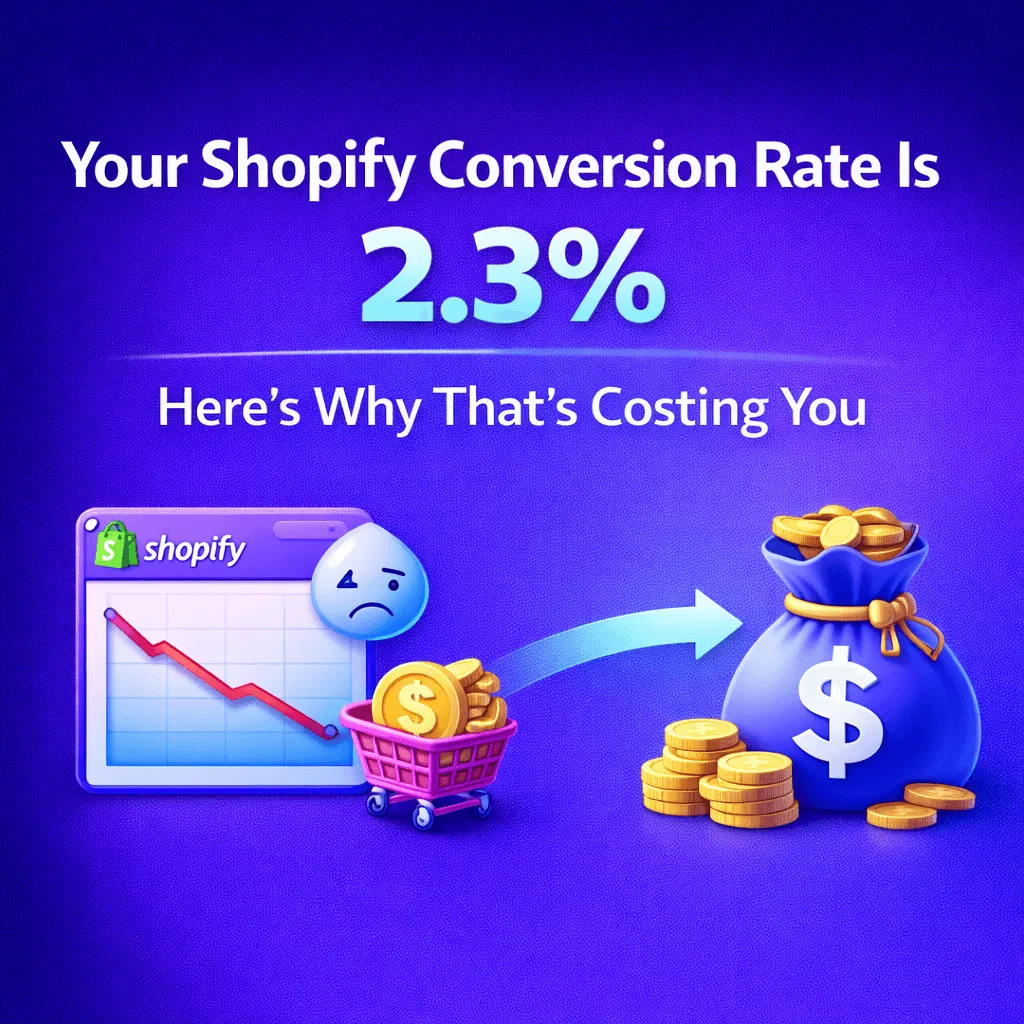
You check your Shopify dashboard every morning.
Conversion rate: 2.3%
You think: “That’s pretty good, right? Industry average is 2-3%.”
Wrong.
That “average” number is killing your business. And here’s why nobody’s telling you the truth about it.
The “2-3% industry average” includes every garbage dropshipping store, every abandoned Shopify trial, every half-built store that gets 10 visitors a month. It’s a meaningless benchmark.
Real DTC brands—the ones doing $1M-$10M annually—don’t convert at 2.3%.
They convert at 4-7%. Some hit 8-10% on specific product pages.
The difference between 2.3% and 5% doesn’t sound like much.
But on 50,000 monthly visitors, that’s the difference between $690,000 and $1.5 million in annual revenue.
You’re leaving $810,000 on the table. Every single year. Because you think 2.3% is “fine.”
I’m going to show you the 8 questions every high-converting DTC store answers perfectly—and the exact spots where your 2.3% is breaking down.
The Brutal Truth About “Industry Average”
Let me show you what’s actually happening with that 2-3% benchmark.
Shopify has 4.4 million active stores.
Maybe 200,000 of those are real businesses doing over $10k/month.
The other 4.2 million are dropshippers, abandoned trials, test stores, side hustles that never launched, and stores getting 50 visitors a month.
When someone calculates “average Shopify conversion rate,” they’re averaging successful brands with complete garbage.
Here’s what actually matters:
Successful DTC wellness brands: 3.5-7% conversion rate
Top 10% of DTC wellness brands: 6-10% conversion rate
Your competition (the brands taking your market share): 4.5-6% conversion rate
Your store at 2.3%: Bottom 40%
You’re not competing against the “average” Shopify store.
You’re competing against the brand that’s converting at 5.8% while you’re stuck at 2.3%.
They’re growing 150% faster than you with the same traffic.
The $127,000 Question: What Are You Missing?
Here’s the math on what 2.3% is actually costing you.
Let’s say you’re doing 50,000 visitors per month. Decent traffic. You’re spending $12k-$18k on ads to get it.
At 2.3% conversion and $60 average order value:
- 50,000 visitors × 2.3% = 1,150 orders
- 1,150 orders × $60 = $69,000/month
- Annual revenue: $828,000
Now let’s say you fixed whatever’s broken and got to 5% conversion (still not even top 10%, just solid):
- 50,000 visitors × 5% = 2,500 orders
- 2,500 orders × $60 = $150,000/month
- Annual revenue: $1,800,000
Difference: $972,000 per year
Even if you only got to 4% (modest improvement):
- 50,000 visitors × 4% = 2,000 orders
- 2,000 orders × $60 = $120,000/month
- Annual revenue: $1,440,000
Difference: $612,000 per year
You’re not just leaving money on the table. You’re leaving a entire year’s salary for 3-4 employees. A warehouse. A second product line. Your growth capital.
All because you thought 2.3% was “pretty good.”
The 8 Questions High-Converting Stores Answer (That Yours Doesn’t)
Every store converting at 5%+ answers these 8 questions perfectly.
Your 2.3% store is failing at least 4 of them.
Let’s go through each question and diagnose where you’re broken.
Question 1: “Is This for Me?” (Answered in 3 Seconds or Less)
What this means:
Someone clicks your ad and lands on a product page.
Within 3 seconds – before they scroll, before they read anything – they should know if this product is for them.
Not “maybe.” Not “I’ll read more and see.”
Immediate yes or no.
Why 2.3% stores fail this:
Your headline is the product name: “Magnesium Glycinate 400mg”
Your hero image is a bottle on a white background
There’s nothing that says who this is for or what problem it solves
The visitor has to read 3 paragraphs to figure out if they’re in the right place
What 5%+ stores do:
Headline answers “for who” and “what outcome”: “Deep Sleep for Anxious Minds That Won’t Shut Off at 3am”
Hero image shows someone like the target customer using the product
Subheadline clarifies the timeline: “Fall asleep in 20 minutes, stay asleep for 8 hours, wake up actually rested”
Zero ambiguity about who this is for
The diagnostic test:
Open your best-selling product page.
Set a timer for 3 seconds.
Look at only what’s visible without scrolling.
Can you answer: Who is this for? What will it do? How long will it take?
If no = You’re losing 60-70% of traffic in the first 3 seconds.
Quick fix (15 minutes):
Rewrite your H1 headline: “[Outcome] for [Specific Person with Specific Problem]”
Example: “All-Day Energy for Moms Running on 5 Hours of Sleep and 3 Cups of Coffee”
Change your hero image to show your target customer using or benefiting from the product
Add a subheadline with timeline: “Feel the difference in 30 minutes, peak energy at 2 hours, no crash at 3pm”
Expected lift: 12-18% increase in time on page, 8-12% decrease in bounce rate
Question 2: “Why Should I Believe You?” (Proof Within First Scroll)
What this means:
After 3 seconds, they know it’s for them.
Next question (within 10 seconds): “Does this actually work or is this another bullshit wellness brand?”
They need proof. Fast.
Why 2.3% stores fail this:
No reviews visible above the fold
No customer photos
No specific results (“helped thousands of customers” doesn’t count)
No clinical data or third-party testing
Just marketing copy and ingredient lists
What 5%+ stores do:
Customer reviews with photos in the first scroll
Specific outcomes: “Sarah lost 14 pounds in 60 days” with her photo
Star rating visible immediately (4.7 stars from 2,847 reviews)
Third-party testing badges (“Tested by ConsumerLab,” “NSF Certified”)
Clinical study callouts if available (“Clinically shown to improve sleep quality by 43%”)
The diagnostic test:
Scroll down one full screen on mobile (the average person’s first scroll).
What proof do you see? Customer photos? Reviews? Test results? Certifications?
If you see zero proof = You’re losing 40-50% of traffic who don’t trust you yet.
Quick fix (30 minutes):
Move your top-rated review to above the fold (right under the product description)
Make sure it has a customer photo and specific results
Add your star rating near the product name (4.8★ from 1,200+ reviews)
Add any third-party certifications or testing badges you have
If you don’t have reviews yet, add “30-day money-back guarantee” in bold near the buy button
Expected lift: 10-15% increase in add-to-cart rate
Question 3: “What If It Doesn’t Work?” (Risk Reversal Before Decision)
What this means:
They’re interested. They’re scrolling. They’re reading.
But they’ve been burned before. Five other supplements that did nothing. Three skincare products that broke them out.
They need to know they’re not risking $60 on another disappointment.
Why 2.3% stores fail this:
Return policy buried in footer or separate page
No mention of money-back guarantee until checkout (or never)
Guarantee has friction (“unopened products only,” “minus shipping,” “store credit only”)
No reassurance at the decision point
What 5%+ stores do:
Money-back guarantee mentioned 3+ times: Product page, cart, checkout
Guarantee is aggressive: “60 days, even if you finish the bottle”
Framed as removing risk: “Try it for 60 days. If you don’t see results, we’ll refund every penny. No questions, no hassle.”
Positioned near every “buy” button or decision point
Some even add: “We’ll even let you keep the product” (for consumables under $50)
The diagnostic test:
From your product page, can you see the money-back guarantee without clicking to another page?
Is it near the “Add to Cart” button?
Is it bold and clear, or buried in fine print?
If it’s not visible and clear = You’re losing 15-25% of risk-averse buyers (which is most people).
Quick fix (10 minutes):
Add guarantee text near your “Add to Cart” button
Copy: “60-Day Money-Back Guarantee: Try [product] risk-free. If you don’t see [specific result] in 60 days, we’ll refund your full purchase. Even if the bottle’s empty.”
Make it bold or put it in a light-colored box so it stands out
Add a small badge/icon (✓ or shield icon) to make it visual
Expected lift: 8-12% increase in add-to-cart rate
Question 4: “How Long Until I See Results?” (Timeline = Trust)
What this means:
People don’t just want to know IF it works. They want to know WHEN it works.
Is this a 3-day thing? A 3-week thing? A 3-month thing?
Without a timeline, they assume the worst (it doesn’t work or takes forever).
Why 2.3% stores fail this:
No timeline mentioned anywhere
Vague language: “See results fast” or “works quickly”
Customer reviews mention timelines but you don’t
Ingredients list but no explanation of how long they take to work
What 5%+ stores do:
Clear timeline on product page: “Most people see results in 2-3 weeks, peak results at 8 weeks”
Week-by-week breakdown for longer timelines:
- Week 1-2: You’ll notice [initial effect]
- Week 3-4: [building effect]
- Week 6-8: [peak results]
Reviews reinforce the timeline: “Worked in 10 days just like they said”
Realistic expectations set upfront (underpromise, overdeliver)
The diagnostic test:
Open your product page and search (Ctrl+F) for: “week,” “day,” “month”
Is there a clear timeline to results anywhere on the page?
If no = You’re losing 20-30% of people who need to know “how long” before committing.
Quick fix (20 minutes):
Add a “What to Expect” section to your product page
Format it as a timeline:
Week 1-2: [What they’ll notice first]
Week 3-4: [What builds over time]
Week 6-8: [Peak results]
Be specific. “Better sleep” is vague. “Fall asleep 15 minutes faster and wake up 40% less during the night” is specific.
Use customer review data if you have it (read reviews and find the average timeline)
Expected lift: 7-11% increase in add-to-cart rate
Question 5: “How Do I Use This?” (Clarity = Confidence)
What this means:
They’re ready to buy. But they’re not sure how to use it.
How much? How often? With food? Without food? Morning or night? With other supplements?
Confusion kills conversion.
Why 2.3% stores fail this:
Usage instructions only on the bottle (which they don’t have yet)
Vague instructions: “Take daily as directed”
No guidance on best practices or timing
No FAQ about common usage questions
What 5%+ stores do:
Clear usage instructions on product page: “Take 2 capsules 30 minutes before bed with water”
Best practices included: “For best results, take consistently at the same time each night”
What to combine with: “Pairs well with our Ashwagandha for even deeper relaxation”
What NOT to combine with: “Avoid taking with caffeine within 4 hours”
FAQ section answers: Can I take this with [common med]? What if I miss a day? Can I take more for faster results?
The diagnostic test:
Pretend you just bought this product and it arrived.
Based only on your product page, do you know:
- How much to take?
- When to take it?
- With or without food?
- How often?
- What to avoid?
If any answer is no = You’re creating uncertainty that prevents purchase.
Quick fix (30 minutes):
Add “How to Use” section to product page
Format: “Take [amount] [when] [with what] for best results”
Example: “Take 2 capsules 30 minutes before bed with 8oz of water. For best results, take at the same time each night. Avoid caffeine after 2pm.”
Add FAQ below with 5 common questions:
- Can I take this with my morning vitamins?
- What if I forget a dose?
- Can I take more for faster results?
- Is this safe with [common medication]?
- How long until I feel it working?
Expected lift: 5-9% increase in add-to-cart rate
Question 6: “Why Is This Better Than What I’m Using Now?” (Competitive Positioning)
What this means:
They’re not coming to your site in a vacuum.
They’re already taking a magnesium supplement (or using a retinol serum, or drinking a greens powder).
Why should they switch to yours?
Why 2.3% stores fail this:
No mention of what makes yours different
Generic benefits that every competitor claims: “High quality,” “organic,” “science-backed”
No comparison to other forms/brands/approaches
Assumes the customer knows nothing (they actually know a lot)
What 5%+ stores do:
Direct comparison: “Unlike magnesium oxide (which most brands use), we use magnesium glycinate for 4x better absorption”
Explain the difference: “Most collagen supplements use bovine (cow) collagen. We use marine (fish) collagen because it’s absorbed 1.5x faster and works better for skin”
Show what you DON’T include: “No fillers, no magnesium stearate, no titanium dioxide (which 90% of brands add)”
Competitive callout without naming names: “If you’ve tried magnesium before and it upset your stomach, that’s because it was the wrong form. Glycinate doesn’t cause digestive issues.”
The diagnostic test:
Read your product page as if you’re already using a competitor’s version.
What specific reason would make you switch?
If there’s no clear “better because” = You’re losing 30-40% of people who are comparison shopping (which is most of cold traffic).
Quick fix (45 minutes):
Add a “Why [Your Product] Is Different” section
Research what your competitors use (ingredient form, sourcing, dosage)
Call out 2-3 specific differences:
- Form: “We use [X form] instead of [Y form] because [specific benefit]”
- Dosage: “Most brands use 200mg. We use 400mg because that’s the clinically studied dose”
- Sourcing: “Grass-fed from New Zealand vs conventional US-sourced”
Back each claim with a reason: “This means you get [specific benefit] vs [common problem with alternatives]”
Expected lift: 10-14% increase in add-to-cart rate, especially on cold traffic
Question 7: “What If I Don’t Like Buying Subscriptions?” (Subscription Positioning)
What this means:
Subscription can increase LTV by 3-5x.
But most people hate subscriptions because they’ve been burned by predatory subscription models.
If you position subscription as a trap, nobody subscribes.
If you position it as flexibility, 30-50% subscribe.
Why 2.3% stores fail this:
Subscription is default (feels pushy)
Discount is tiny (5-10% isn’t worth the commitment)
Manage/cancel process is unclear
No mention of flexibility (skip, pause, change frequency)
Dark patterns (hard to cancel, auto-charges with no warning)
What 5%+ stores do:
One-time purchase is default (low pressure)
Subscription discount is meaningful (15-25% off)
Flexibility is front and center: “Skip, pause, or cancel anytime from your account – no phone calls, no emails”
Reminder emails before charging: “Your next order ships in 3 days – skip or modify now”
Easy-to-find manage link in every email and on account page
Transparent: “We’ll remind you 3 days before each shipment so you’re never surprised”
The diagnostic test:
If you offer subscription, try this:
Sign up for your own subscription
Try to skip a shipment – can you do it in under 30 seconds?
Try to cancel – can you do it without emailing support?
Check your emails – do you get reminders before being charged?
If any answer is no = Your subscription is positioned as a trap, and conversion suffers.
Quick fix (1 hour):
Change your product page copy around subscription
Before: “Subscribe and Save 15%”
After: “Subscribe and Save 15% – Skip, pause, or cancel anytime. No commitments, no phone calls. We’ll remind you before every shipment.”
Set up pre-charge reminder email:
3 days before shipment: “Your [product] ships in 3 days! [Manage subscription] [Skip this order] [Change frequency]”
Make “Manage Subscription” the first link in your customer account dashboard
Add a visible “Cancel Subscription” button (one click, no forms)
Expected lift: 12-18% increase in subscription take rate, 25-35% decrease in subscription churn
Question 8: “Why Should I Buy Right Now?” (Urgency Without Slime)
What this means:
They like the product. They trust you. They’re going to buy.
But maybe not right now. They’ll think about it. Come back later. Compare a few more options.
85% of “later” never happens.
You need a reason for “now.”
Why 2.3% stores fail this:
No urgency at all (they’ll come back… they won’t)
Fake urgency (countdown timer that resets, “only 2 left!” that’s always 2)
Aggressive urgency (too salesy, breaks trust)
Discount required for urgency (trains customers to wait for sales)
What 5%+ stores do:
Real inventory scarcity: “47 in stock” (if actually true)
Social proof urgency: “127 sold in the last 24 hours”
Shipping deadline: “Order in next 4 hours for same-day shipping”
Limited edition or seasonal: “Available until [date] or while supplies last”
Launch urgency: “New formula – early access ends Friday”
First-order incentive: “First-time customers save 15% today”
The diagnostic test:
Look at your product page.
Is there any reason to buy today vs next week?
If no = You’re losing 40-60% of “interested but not urgent” visitors who leave and never return.
Quick fix (20 minutes):
Pick ONE urgency method (don’t stack 5, that’s desperate):
If you have real inventory tracking: Show stock level when under 100 units
If you have good traffic: Show social proof “X sold in last 24 hours” or “X people viewing this now”
If you ship same-day: Add “Order within [time] for same-day shipping”
If you have a first-order offer: “New customers save 15% on first order – discount auto-applied at checkout”
Make it visible near Add to Cart button
Expected lift: 8-14% increase in conversion rate
The 2-Minute Audit: Which Questions Are You Failing?
Go through each question and score yourself.
| Question | Pass/Fail | Why You Failed |
|---|---|---|
| 1. Is this for me? (3 sec answer) | ☐ | |
| 2. Why believe you? (proof in first scroll) | ☐ | |
| 3. What if it doesn’t work? (visible guarantee) | ☐ | |
| 4. How long for results? (timeline on page) | ☐ | |
| 5. How do I use this? (clear instructions) | ☐ | |
| 6. Why switch from current? (competitive edge) | ☐ | |
| 7. Will subscription trap me? (easy to manage) | ☐ | |
| 8. Why buy now? (real urgency) | ☐ |
If you failed 5-8: You’re at 1.5-2.5% conversion. This is why you’re stuck.
If you failed 3-4: You’re at 2.5-3.5% conversion. You’re close to breaking through.
If you failed 1-2: You’re at 3.5-4.5% conversion. Fix these last gaps and you’ll hit 5%+.
If you passed all 8: You should be at 5-7% conversion. If not, your problem is traffic quality (wrong audience, wrong channel, wrong offer).
What Happens When You Answer All 8 Questions
Let’s go back to our earlier example.
50,000 monthly visitors. $60 AOV.
Before (failing 4-5 questions):
Conversion rate: 2.3%
Monthly orders: 1,150
Monthly revenue: $69,000
Annual revenue: $828,000
After (answering all 8 questions):
Conversion rate: 5.2%
Monthly orders: 2,600
Monthly revenue: $156,000
Annual revenue: $1,872,000
Difference: $1,044,000 per year
That’s not from spending more on ads. Not from launching new products. Not from going viral on TikTok.
Just from answering 8 simple questions that your visitors are already asking.
Real Example: $47k to $91k in 60 Days
Wellness brand came to us stuck at $47k/month for 6 months.
Traffic was fine (22,000 monthly visitors). ROAS was profitable (2.8x).
Conversion rate: 2.1%
We ran them through the 8 questions. They were failing 6 of them.
Here’s what we fixed:
Question 1 (Is this for me): Rewrote headlines to state exact outcome for exact person
Question 2 (Why believe): Moved reviews with photos above fold, added star rating to product name
Question 3 (What if it doesn’t work): Added 60-day guarantee near every buy button
Question 4 (How long for results): Added week-by-week timeline section
Question 6 (Why switch): Added “Why Our Ashwagandha Is Different” section comparing forms and sourcing
Question 8 (Why buy now): Added “First order: 15% off auto-applied” with real inventory count
Results after 60 days:
Conversion rate: 4.7% (up from 2.1%)
Monthly orders: 2,034 (up from 994)
Monthly revenue: $91,530 (up from $47,100)
Lift: +94% revenue from the same traffic
They didn’t change their product. Didn’t increase ad spend. Didn’t hire more people.
They just answered the 8 questions their visitors were already asking.
Why Most Founders Never Fix This
You’re too close to your product.
You know it works. You know the ingredients. You know the science. You know why it’s better.
So you assume your customers know all of this too.
They don’t.
They landed on your site 8 seconds ago from a Meta ad. They have 4 other tabs open comparing you to competitors.
They’re asking these 8 questions whether you answer them or not.
If you don’t answer them, they leave.
If you do answer them, they buy.
It’s that simple.
Start Here Today
Pick your 3 worst-scoring questions from the audit.
Fix those first.
Each fix takes 15-45 minutes.
That’s 90 minutes of work to fix 3 questions.
Those 3 fixes will lift your conversion rate 0.8-1.5 percentage points in the next 14 days.
On 50,000 monthly visitors, that’s $15,000-$35,000 more revenue per month.
Or, if you want someone to audit your entire store, answer all 8 questions for you, implement the fixes, and track the lift, that’s exactly what we do.
We’ve done this for 60+ DTC wellness and skincare brands stuck under 3% conversion.
Average lift: 85% increase in conversion rate within 60 days.
Get your free conversion audit here
We’ll analyze your store against all 8 questions, show you exactly which ones you’re failing, calculate how much each failure is costing you per month, and give you a prioritized fix list.
One last question before you go:
Which of the 8 questions do you think you’re failing hardest?
Fix that one today. Right now. Before you close this tab.
Your 2.3% conversion rate isn’t a permanent condition.
It’s just 8 unanswered questions.
Answer them, and watch what happens.